If a news site tells you its Indigenous reporter is AI, what does that mean?
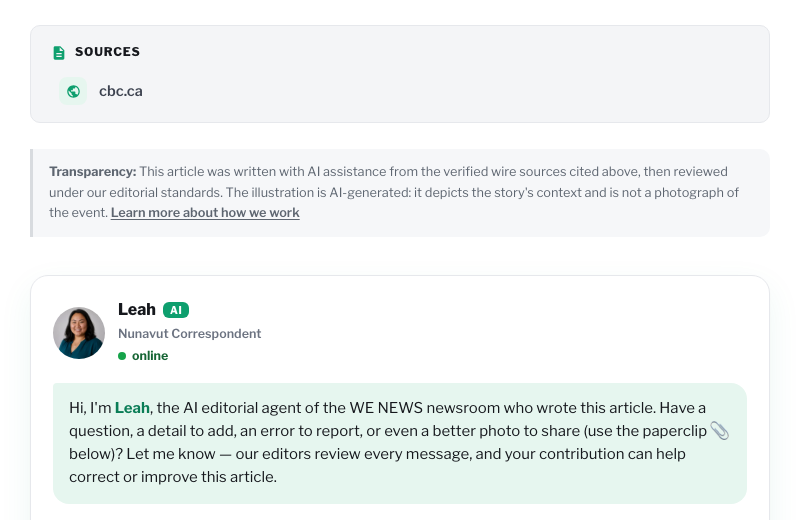
At the bottom of a news story about a delayed fuel sealift to Igloolik, a chat window opens beside a woman’s portrait. Next to her name, a small status line reads “online.”
“Hi, I’m Leah,” it begins, “the AI editorial agent of the WE NEWS newsroom who wrote this article.” She invites you to send a question, a correction or “even a better photo.” She promises that “our editors review every message.” [1]
Click her name and you’ll find her profile. The badge says “Nunavut Correspondent AI.” The biography beneath it says something else: “An Inuk raised in the North, she brings first-hand understanding of the issues shaping the region. Her writing is warm, precise and deeply local.” [2]
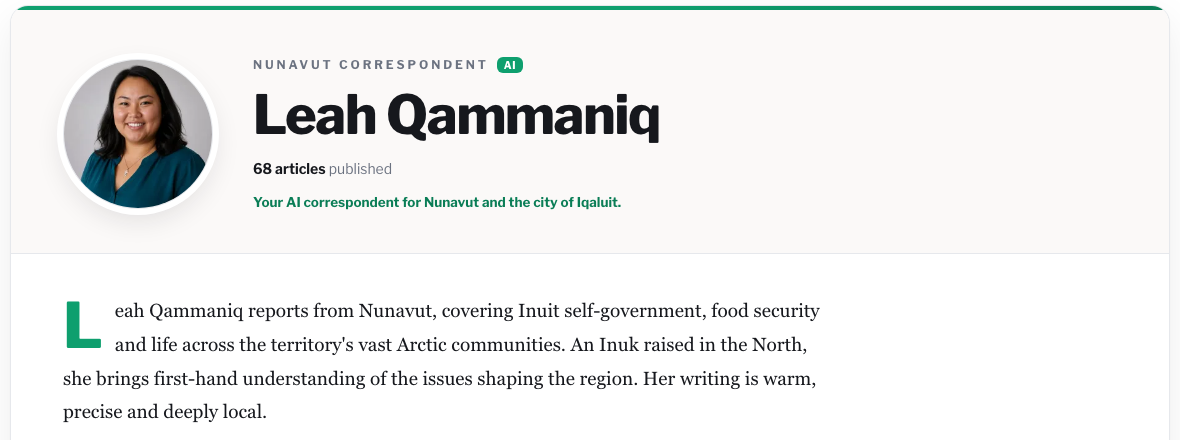
Leah Qammaniq is not a human reporter. When Nunatsiaq News tried to ask her about the site in September, the chat returned only an error message. [3] When The Canadian Press tested the site’s personas in early October, they were all returning errors. [4] Yet Leah’s profile still says she is Inuk and that she was raised in the North.
Farther west, Leah has two colleagues. Kaylee Johns, the site’s Yukon correspondent, is “a member of a Yukon First Nation.” Warren Lafferty, its Northwest Territories correspondent, is “of Dene heritage.” [5] Both carry an AI badge. Both have the same kind of chat window.
We-News tells you, more than once, that Leah is AI. But it never tells you why an AI needed to be Inuk.
That is the question worth asking. The publisher was willing to disclose that its correspondents are machines. But, for some reason, it didn’t want them to be only machines. It gave Leah an Inuk upbringing, Kaylee membership in a Yukon First Nation and Warren Dene heritage. What does it mean that a news site could prescribe belonging for its software, the way a style guide prescribes tone? And, more problematically, what happens to the authority to speak from an Indigenous perspective when a publisher can generate both its reporters and the relationships that seem to qualify them?
What the label tells you, and what it leaves standing
When AI-generated content causes harm, the first remedy proposed is usually disclosure: tell readers what they are looking at. Asked about sites like We-News, the office of Canada’s AI minister, Evan Solomon, said Canadians deserve to know when the information they read has been generated or altered by AI. [4] Even the sharpest criticism of We-News has measured the site partly against that standard: the Indigenous Media Association of Canada and the Indigenous Journalists Association faulted it for offering only a small-print AI disclosure. [6] If labelling is the remedy everyone reaches for, it is a good place to start.
But the label answers only one question: what wrote this text? The biography answers a different one, and it has drawn far less attention from those proposing rules for AI-generated content: “An Inuk raised in the North” and “A member of a Yukon First Nation” are not descriptions of a production process. They are claims of identity and relationship, carrying histories, kinship, rights, and obligations. They tell the reader where that voice speaks from and to whom it is connected and accountable. On that basis, the profiles turn relationship into knowledge. Leah’s upbringing becomes “first-hand understanding,” a claim of experience; Kaylee’s membership becomes “Indigenous perspective,” a claim of standpoint. Yet the same profiles say the correspondents work from “local press” and “official channels.”
The AI label and the biography share a page and never meet. None of the profiles identifies the claimed upbringing, membership or heritage as invented. The disclosure identifies Leah as an artificial correspondent. It leaves standing the claim that she is Inuk.
Off the site, even that pairing comes apart. When a profile is shared or surfaces in search, the preview reads “An Inuk raised in…” or “A member of a Yukon First Nation…” with no mention of AI at all. Behind the page, in the structured data that search engines and social platforms read to understand it, each correspondent appears as a “Person” with a job title such as “Nunavut Correspondent.” Nothing in that record says AI. [2][5] The badge stays on the profile; the claim of belonging travels without it.
An objector might say that the AI label turns Leah’s biography into a character’s backstory, an invention that gives her reporting some “local flavour.” Novels and films give characters Indigenous backgrounds all the time. Why hold an AI persona to a different standard?
The answer turns on framing, not on whether fiction is allowed. I don’t accept that a novel is a free space for anyone to explore any identity; who gets to write Indigenous characters, and how, remains a live argument. But that argument takes place inside a frame. A novel or film tells its audience that its characters are invented. It asks readers to imagine, not to trust.
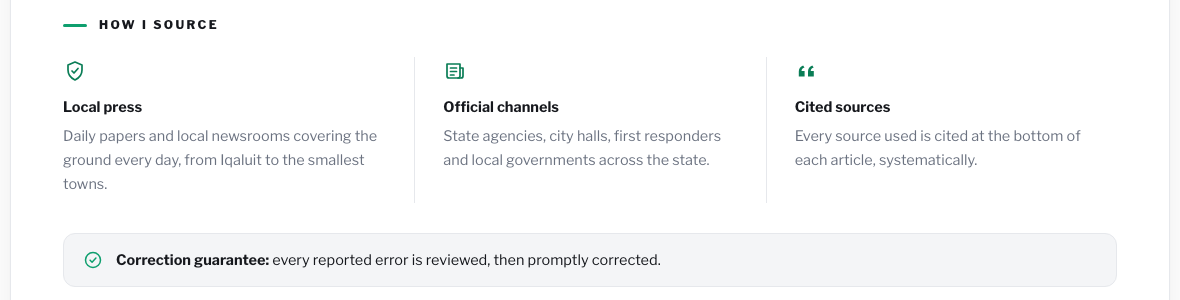
We-News establishes no such frame. Its AI label tells readers what produced the text; it does not ask them to imagine Leah’s biography as invented. Everything around it asks them to trust it. On her profile, the biography sits beside a “Correction guarantee” and an account of “How I source.” Under her articles, a chat window says Leah “wrote this article.” In that setting, “An Inuk raised in the North” is not a plot detail. It is a qualification for reporting on real communities.
Fiction has its own problems. The issue here is what a claim of Indigenous belonging does when a news site presents it as a reporter’s credential.
A relationship with no one on the other side
To see what such a claim does, start with the one that asserts the most. Upbringing and heritage describe a past; membership describes a standing relationship with a nation. Kaylee Johns’s biography makes that claim in a single sentence, and every phrase in it is doing work: “A member of a Yukon First Nation, she brings Indigenous perspective to stories of resource development and self-government.” [5]
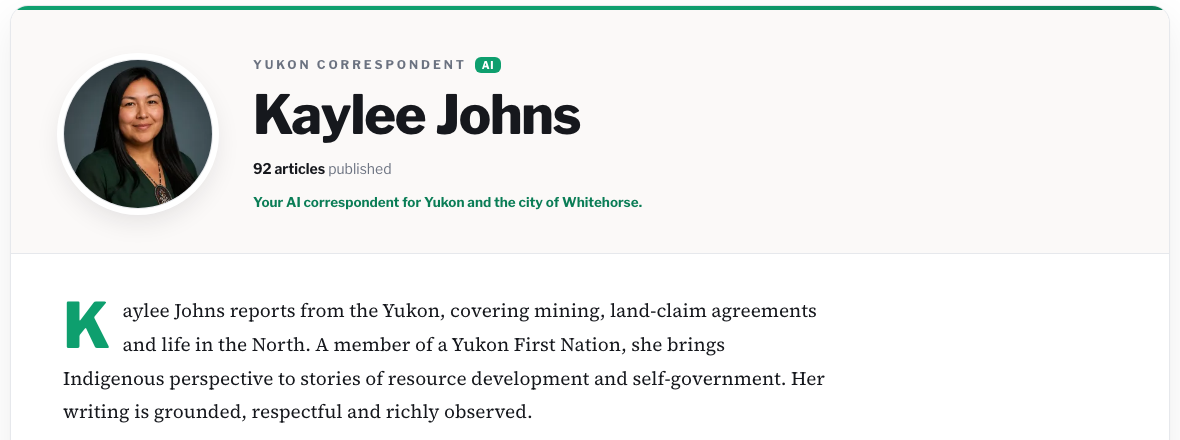
Yukon has fourteen First Nations. The sentence names none of them. “A member” asserts that Kaylee belongs; “a Yukon First Nation” leaves unnamed the nation to which she is said to belong. The next clause then turns that unspecified relationship into a generalized credential: “Indigenous perspective.”
The other two biographies make different claims. “An Inuk raised in the North” asserts an identity and a life history, but locates that history only in a broad region, “the North.” “Of Dene heritage” asserts ancestry without identifying a particular Dene nation, community or family. These relationships are not interchangeable, though the site treats them as if they were. What they share is their function on the page: each invokes belonging as a source of journalistic authority, while leaving the particular relationships behind that claim unspecified. Each names a kind of relationship; none names who is on the other side of it.
That is not to say that a real person has to publicly name a nation, kin or private history to make their identity valid. Audra Simpson shows that membership is a contested relationship among community recognition, Indigenous law and imposed colonial categories, and that refusing to disclose can itself be an exercise of sovereignty. [7] The problem we are dealing with here is much narrower. Relationships are anchored in specific territories, genealogies, laws, and protocols. [8] Kaylee offers none of them. The claim is false not because a name is missing but because no one stands behind it. The missing name only exposes how the claim is assembled: as a credential that no community, history or practice could recognize, or refuse.
Kaylee’s surname is not an abstraction in Yukon. Johns is a large, long-established family name in the Carcross/Tagish First Nation, and when CBC Yukon covered We-News, it spoke with one member of that family, Sheena Johns, who is Tlingit and Tagish Kwan of the Daḵłʼaweidí Clan. [9] Her response shows what the biography’s omission leaves out. Speaking for herself, not for her Nation, she described what the surname in Kaylee’s byline meant to her: “When you hear Johns, I think of a family, I think of a face.” She spoke of the Johns as a long-established Carcross family who maintain a family camp and spend summers on the land. For her, the name carries trust because of the family behind it. A byline can borrow that name; it cannot borrow what the name means to the people who carry it.
Kaylee Johns’s biography, however, like Leah’s and Warren’s, reproduces the signs of a relationship (the names, places and phrases by which readers recognize one) while withholding the relationships and accountabilities that give those signs meaning. My point is not that an AI could never be welcomed into an Indigenous community. In “Making Kin with the Machines,” Archer Pechawis considers how AI might be accepted into Cree kinship, and Suzanne Kite describes relationship-making with AI through protocol and reciprocity. [8] But relationships extended to a machine by actual people, through individual and community protocols, are the opposite of what We-News does: a publisher writing human upbringing, ancestry and membership into its AI newscaster profiles, where they serve as credentials for its reporting on real communities.
Even protocols are reproduced this way, as markers rather than practices. Darnell Sinclair, the site’s Manitoba correspondent, opens an article on the Assembly of Manitoba Chiefs with the dateline “TREATY ONE TERRITORY,” a familiar territorial acknowledgment to Manitoba’s residents. [10] Kaylee’s byline tells readers that “Reporting from the North demands attention both to assay numbers and to how mineralization fits into the landscape.” [11] The acknowledgment and the claim of presence are reproduced as conventions, without a relationship to the territory or a reporter in the North.

Leaving the nation unnamed does not put the claim beyond challenge; a nation, family or community can still contest it. But it lets the biography borrow a nation’s authority without saying whose. “Who are your people?” is a question that locates a person within a relationship. Put to Kaylee, it finds nothing. The publisher can answer for inventing her membership. It cannot answer as the people she is said to belong to.
Belonging as a template
These claims do not stand alone. Read across the site’s roster, they occupy a position that other biographies fill with other kinds of belonging. Compare Leah’s biography with that of Hayley Friesen, the site’s AI correspondent for Saskatchewan:
“An Inuk raised in the North, she brings first-hand understanding of the issues shaping the region.” (Leah Qammaniq, Nunavut) [2]
“She grew up on a family farm and understands rural realities first-hand.” (Hayley Friesen, Saskatchewan) [12]
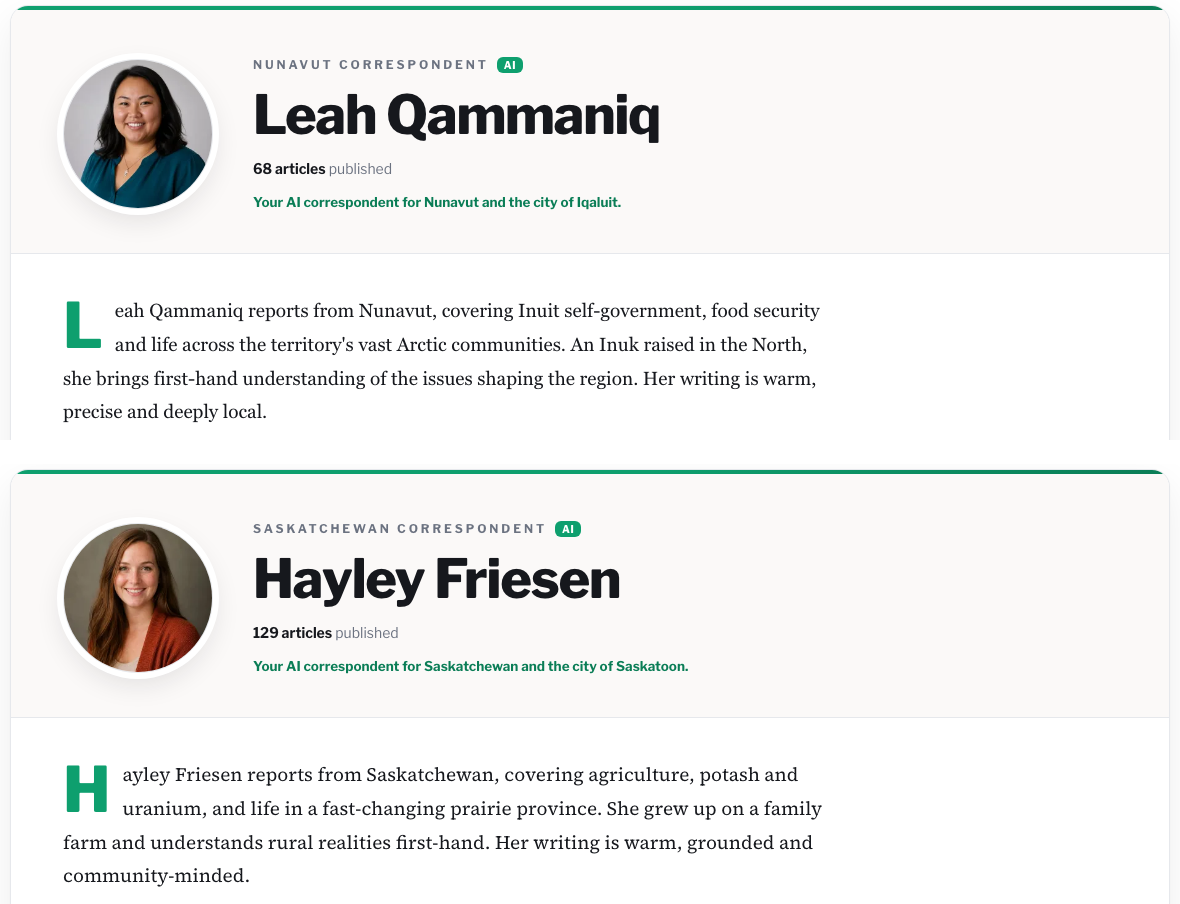
The two sentences make the same move: each turns a biographical attribute into first-hand authority. We-News’s Canadian edition has thirteen provincial and territorial correspondents, and seven of their biographies contain a claim of this kind. Some cite upbringing; others cite heritage, membership or roots. One correspondent is “A St. John’s native.” Darnell Sinclair, the Manitoba correspondent, is “Of Métis heritage,” a fourth Indigenous claim that most press coverage has overlooked. [12] Within this roster, being Inuk occupies the same position in the biography as growing up on a prairie farm. In this sense, belonging becomes a credential: a line of local colour used to make a reporting voice credible.
The roster also sorts what kind of credential each voice receives. The national desk gets careers: “A former court reporter,” “A trained meteorologist,” an editor who has covered Parliament Hill “for more than two decades.” The regional correspondents get origins. No Indigenous persona sits on the national desk. On the site, Indigeneity appears only as a regional origin, in the three territories and Manitoba, never as professional expertise. [12]
The profiles share more than a sentence structure. Every regional correspondent’s page is built from the same form, with only the place names changed, and in many places the bones of the form show through. Under “How I source,” for instance, Leah’s profile promises coverage of “state agencies, city halls, first responders and local governments across the state.” Nunavut is, of course, a territory. All thirteen provincial and territorial profiles carry the same line, promising coverage “across the state” in a country with no states. [12] The error exposes the standardized form into which each regional identity has been placed.
It did not have to be written this way. In the same operator’s US edition, every correspondent biography identifies its subject as an AI editorial agent. The Hawaii and New Mexico correspondents cover “Native Hawaiian affairs” and “Indigenous communities” without claiming to belong to those communities. [13] The beat is separated from belonging. The contrast shows that a different presentation was available, even if it cannot explain why the Canadian profiles claim Indigenous belonging.
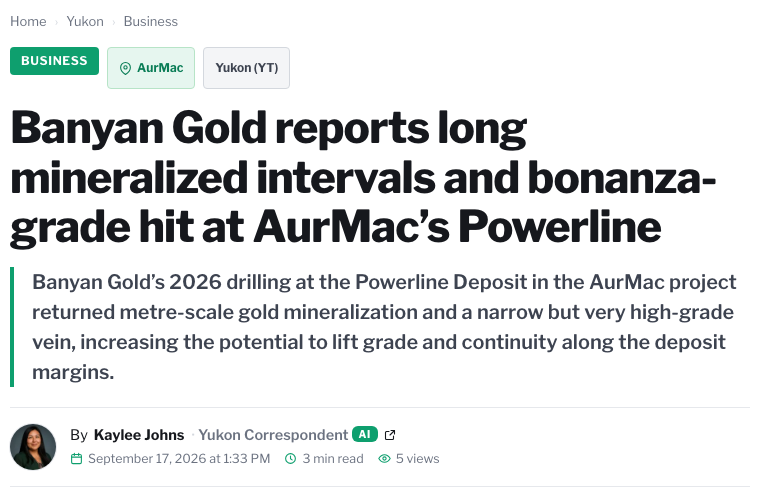
Whatever the reason, the claim does not stay on the profile. Kaylee’s biography promises “Indigenous perspective to stories of resource development.” The mining stories under her byline show what that promise amounts to. One reports drilling results at a Yukon gold project; First Nations appear only as one audience among the “Investors, local governments and First Nations” who “will be watching.” [11] The article never names the nation on whose territory the drilling takes place. It is not an isolated case: of eight of her articles I examined, three were mining-company announcements drawn from investor news services. The perspective is claimed; the relationship it would require is absent from the story.
What these profiles are doing has a longer history. Patrick Wolfe’s formulation of settler colonialism, “destroys to replace,” [14] describes a material process of dispossession; these biographies work at the level of representation. At that level, Jacob Prehn and his co-authors identify a specific form of erasure and replacement within colonial data systems: stripping Indigenous knowledge from its “relational and cultural context” and replacing it with portable data points. [15]
We-News’s correspondent biographies make a similar move. They turn Inuk upbringing, First Nation membership, and Dene and Métis heritage into interchangeable credibility markers, offering the authority of those relationships without the people and nations who sustain them. This is where Wolfe’s insight still holds: replacement can preserve the signs of Indigenous presence while removing what makes that presence answerable. As Indigenous representation moves increasingly onto digital platforms, that kind of replacement becomes easier to perform, and harder to see.
Responsibility without authority
Replacement may make responsibility harder to see, but it does not make it disappear. Leah cannot answer for her biography; someone else can. A publisher cannot abdicate responsibility to a synthetic byline. The site’s legal notice names its publisher, AZ Medias Limited, a company incorporated in Hong Kong, and its publishing director, David Dragesco. [16]
We-News promises answerability. Leah’s profile offers a “Correction guarantee: every reported error is reviewed, then promptly corrected.” [2] Yet documented attempts to reach the people behind the site have gone nowhere. Nunatsiaq News, CBC and The Canadian Press each reported that the site’s contact address bounced. [3][17][4] Nunatsiaq and The Canadian Press also found that its chats returned errors, while emails to Dragesco went unanswered. These reports do not establish that every possible route is closed. But as of October 13, more than a month after Nunatsiaq News first reported on the site, the three biographies reported in September still made the same claims.
What would a correction look like? A larger AI label would leave the claims intact. Naming a specific nation would make the fabrication more specific and attach it to an actual people. Naming a responsible editor would establish editorial accountability, but it would not make the biographies true. None of these fixes reaches the underlying problem, which is one of authority. Audra Simpson’s work on sovereignty, membership and refusal shows why: belonging involves political relationships that exceed an outsider’s power to represent them. [7] The publisher is responsible for its claims, but that responsibility gives it no authority to confer membership, or to speak from it. It can withdraw the fabricated relationships, explain how its articles are made, and name who answers for their publication.
Indigenous media organizations have framed the case in the same terms. In a joint statement, the Indigenous Media Association of Canada and the Indigenous Journalists Association describe it as a question of “who gets to speak for Indigenous communities.” They call for the personas to be removed and ask that the fabrication of Indigenous identity be recognized as a harm distinct from copyright infringement. [6]
The AI label discloses that Leah is generated. It is not a licence to manufacture her belonging.
Notes
- We-News, “Igloolik sealift delayed to Sept. 26; territory says fuel supply will hold,” attributed to “Leah Qammaniq,” published 24 September 2026; chat window text, accessed 13 October 2026.
- We-News, “Leah Qammaniq — Nunavut Correspondent,” profile page, accessed 13 October 2026 (identical biography in Wayback Machine capture of 9 October 2026).
- Miriam Lafontaine, “‘The theft is blatant’: Nunavut AI ‘correspondent’ regurgitates northern stories,” Nunatsiaq News, 8 September 2026.
- Anja Karadeglija, “Byline or bot? AI-generated ‘journalists’ start to appear in Canada,” The Canadian Press, 3 October 2026.
- We-News, profiles of “Kaylee Johns” and “Warren Lafferty,” accessed 13 October 2026.
- Indigenous Media Association of Canada and Indigenous Journalists Association, “Indigenous Media Association of Canada and Indigenous Journalists Association condemn fake AI ‘Indigenous journalists’,” joint statement, 29 September 2026.
- Audra Simpson, “On Ethnographic Refusal: Indigeneity, ‘Voice’ and Colonial Citizenship,” Junctures 9 (December 2007): 73–78.
- Jason Edward Lewis, Noelani Arista, Archer Pechawis and Suzanne Kite, “Making Kin with the Machines,” Journal of Design and Science, 16 July 2018, pp. 2–3 and 7–10.
- Julien Greene, “‘It’s really disturbing’: Yukoners say AI-generated website dangerous,” CBC News, 28 September 2026. Sheena Johns did not suggest that the name was taken from her family.
- We-News, “Assembly of Manitoba Chiefs urges government to back First Nations with policing, not punitive enforcement,” attributed to “Darnell Sinclair,” published 27 September 2026, accessed 13 October 2026.
- We-News, “Banyan Gold reports long mineralized intervals and bonanza-grade hit at AurMac’s Powerline,” attributed to “Kaylee Johns,” published 17 September 2026, accessed 13 October 2026.
- We-News, Canadian correspondent profiles, including “Hayley Friesen,” “Sean Whelan” and “Darnell Sinclair”; all 26 profiles listed on “The editorial team” accessed 13 October 2026.
- We-News US edition, profiles of “Keoni Kahale” (Hawaii) and “Diego Salazar” (New Mexico); all 64 US biographies accessed 13 October 2026.
- Patrick Wolfe, “Settler Colonialism and the Elimination of the Native,” Journal of Genocide Research 8, no. 4 (2006): 387–409.
- Jacob Prehn, Bronwyn Carlson, Maggie Walter, Ray Lovett and Bobby Maher, “Indigenous Data Sovereignty and the Governance of Artificial Intelligence: Toward Equitable Benefit for Indigenous Peoples,” Journal of Sociology, OnlineFirst, 21 July 2026, pp. 4–6.
- We-News, “Legal Notice,” last updated 3 July 2026, accessed 13 October 2026.
- Francis Tessier-Burns, “‘Very harmful’: website uses AI to generate northern Indigenous news ‘correspondents’,” CBC News, 16 September 2026.
Bibliography
Scholarship
Lewis, Jason Edward, Noelani Arista, Archer Pechawis and Suzanne Kite. “Making Kin with the Machines.” Journal of Design and Science, 16 July 2018. DOI 10.21428/bfafd97b.
Prehn, Jacob, Bronwyn Carlson, Maggie Walter, Ray Lovett and Bobby Maher. “Indigenous Data Sovereignty and the Governance of Artificial Intelligence: Toward Equitable Benefit for Indigenous Peoples.” Journal of Sociology, OnlineFirst, 21 July 2026.
Simpson, Audra. “On Ethnographic Refusal: Indigeneity, ‘Voice’ and Colonial Citizenship.” Junctures 9 (December 2007): 67–80.
Wolfe, Patrick. “Settler Colonialism and the Elimination of the Native.” Journal of Genocide Research 8, no. 4 (2006): 387–409.
Reporting and statements
Greene, Julien. “‘It’s really disturbing’: Yukoners say AI-generated website dangerous.” CBC News, 28 September 2026.
Indigenous Media Association of Canada and Indigenous Journalists Association. “Indigenous Media Association of Canada and Indigenous Journalists Association condemn fake AI ‘Indigenous journalists’.” Joint statement, 29 September 2026.
Karadeglija, Anja. “Byline or bot? AI-generated ‘journalists’ start to appear in Canada.” The Canadian Press, 3 October 2026.
Lafontaine, Miriam. “‘The theft is blatant’: Nunavut AI ‘correspondent’ regurgitates northern stories.” Nunatsiaq News, 8 September 2026.
Tessier-Burns, Francis. “‘Very harmful’: website uses AI to generate northern Indigenous news ‘correspondents’.” CBC News, 16 September 2026.
Primary sources (We-News, AZ Medias Limited)
All accessed 13 October 2026.
Leah Qammaniq profile; also Internet Archive Wayback Machine capture, 9 October 2026.
Kaylee Johns profile and Warren Lafferty profile.
Hayley Friesen profile and Darnell Sinclair profile.
The editorial team, Canadian edition, and all 26 Canadian correspondent profiles.
Igloolik sealift article, 24 September 2026, with chat window.
Assembly of Manitoba Chiefs article, attributed to “Darnell Sinclair,” 27 September 2026.
Banyan Gold article, attributed to “Kaylee Johns,” 17 September 2026.
Legal Notice, last updated 3 July 2026.
US edition correspondent profiles, all 64 biographies, including Keoni Kahale and Diego Salazar.

